Couponing is dead - long live couponing
Anyone who is around for online shopping for more than a decade might have noticed it: Something changed within the couponing space – it just feels broken nowadays.
When I was talking to people about my plans to leave my secure corporate job to jump on an entrepreneurial gambling with a coupon app, the feedback I received – usually in combination with some eye rolling – was always along these lines:
Hence, I started with some deeper research in this field and my findings were quite surprising: Coupons are not dead – in contrary, they are still flourishing, but the system behind it changed.
The Golden Era
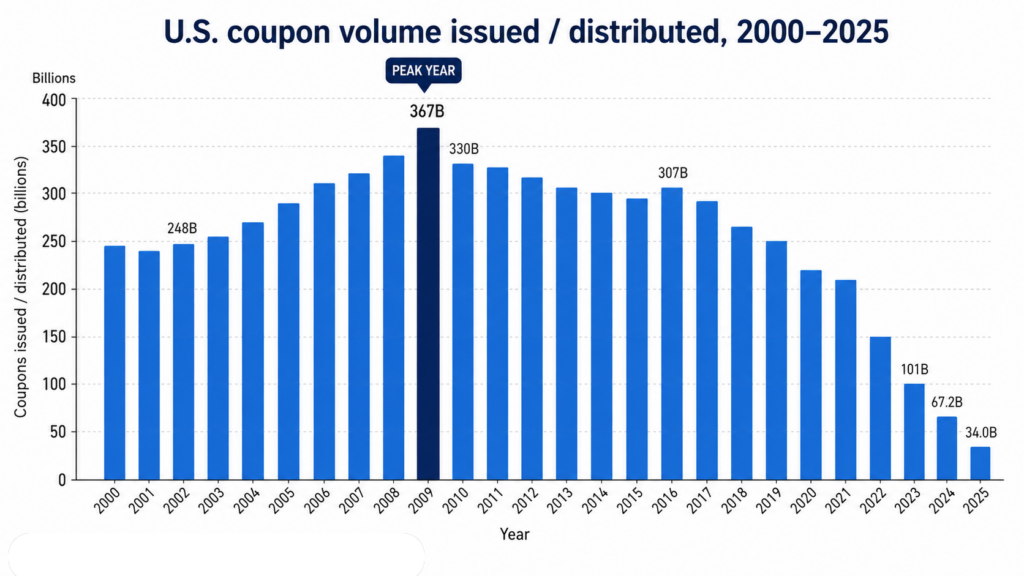
To understand where we are today with coupons requires taking a brief look into the past. Coupons where already a thing before the internet came around – long before. However, peak couponing was probably reached around 2010-2012, right after the Great Recession of 2008. This is the time in which the “Extreme Couponing” TV show on TLC network became popular, featuring among others also shady and probably fraudulent couponing techniques that allow some buyers leaving the store with bags of products almost paying nothing (Cataldo 2011).
This was also the time when Groupon – the daily deal site – was at its zenith and went for IPO, and contemporary coupon sites estimated the number of published coupons around 350 billion in the USA alone. Perfect soil to start a browser extension called “Honey” that will later become known not only for an amazing exit of about 4 billion USD in cash to PayPal (PayPal 2020), but also as the biggest affiliate marketing scam in history.
The Downfall
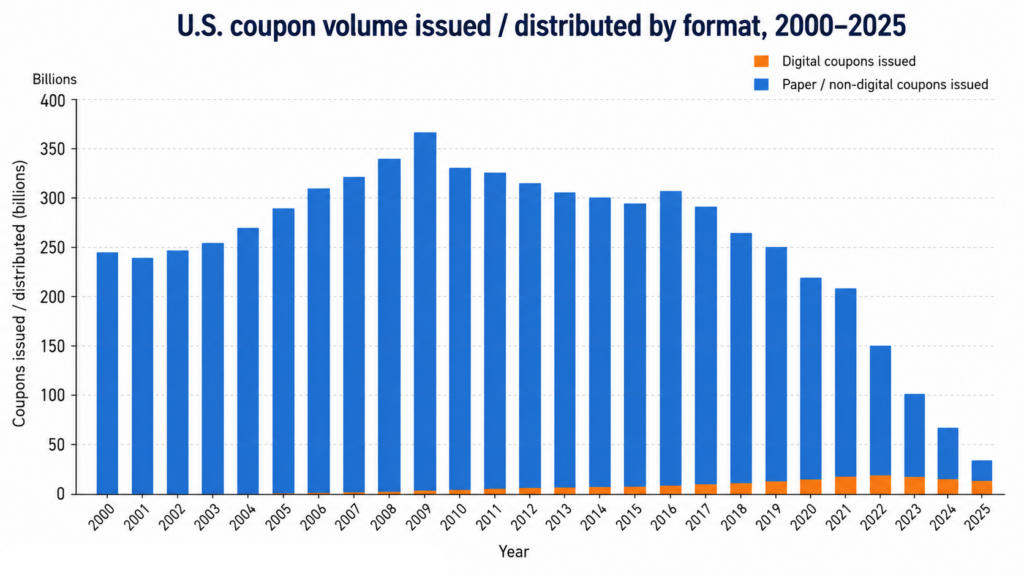
Not long after this golden era of couponing, the situation changed. Shops started to cut rebates and tighten their terms of coupon stacking and redemption periods to safeguard their margins in the face of rising popularity of extreme couponing. Groupon merchant partners realized increasingly that the high discounts offered through the Groupon platform (a losing business in expectation of a long-term increasing customer base) did not lead to a sustainable business with loyal customers but attracted mainly bargain hunters. The volume of issued coupons shrunk along side with their discount rates, and the whole coupon market started to move even faster from traditional paper coupons into the digital world of coupon codes and loyalty apps. Shops attitude towards coupons changed to some extent, especially for paper coupons.
Honey Extension
Right into this trend from paper to digital couponing, the Honey browser extension was born. The idea as simple as revolutionary: upon checkout at online stores, the browser extension tried out all the coupon codes in its database – automatically. Floating upon this simple but useful idea, a good founder story, and very strategic influencer marketing, the extension strived for higher goals and acquired in the years from 2014 to 2020 around 17 million active users.
While paper coupon distribution further diminished, digital coupons especially in the context of online shops still flourished – this was when coupon browser extensions and coupon sites in general just worked fine in the eyes of their users. But there was one problem – in some sense very similar to the issues that caused the crash of brick-and-mortar couponing around 10 years earlier: unintended use or plain misuse of the coupon codes destroyed again the margins of the shops. And in the epicenter of the earthquake stood Honey – not as the sole originator, but as the most prominent of its kind.
Honey Scam
So, what happened? Well, there are multiple layers to the uproar of the story, which was initially covered very well by Megalags viral video on Youtube (MegaLag 2024). The allegations include last-click override which might have harmed creators and influences (the same that also advertised Honey a lot through their accounts), potentially wrong claims regarding the coupon code selection during automatic application, and some controversial about handling user privacy.
But for the online shop owners the most harmful problem allegedly caused by Honey and its competitors was the leakage of coupon codes. In a time, where published coupon codes where usually generic codes (think of code such as SAVE10) that could be redeemed by anyone who knew the code, getting grip of these codes and serving it automatically to anyone who had the browser extension installed could really harm the margins of the shop up to a point where profitability was no longer secured. And Honey was accused of reading these codes from its users if they manually applied them during checkout process and publishing them without consent to hundreds or thousands of other users.
Why are coupon platforms felt to work no longer properly?
Already before the public backslash of the Honey Scam, this trend was visible: Merchant partners of coupon sites experienced ever decreasing value in the type of traffic that coupon sites did provide them on a commission basis as their affiliate partners. The promise of Honey and its competitors was to improve the conversion rate of shops by reducing the abandoned cart problem – the problem that customers after filling their online shopping cart stop in the checkout process and go back to for example Google to search for coupon codes for this shop or for better product offers in other shops. The pitch was that with some low discount coupons, the customer would be motivated to finish the checkout instead of continuing the journey elsewhere.
But how big of a gain was the proposed solution by Honey? Was it worth a discount of in average 7% (a number derived from competitor’s publications (CouponFollow 2021), not including the alleged coupon code leakage of high value codes) to a large fraction of customers? In addition, Honey received a commission of about 5%-10% of the purchase value, sometimes also higher (Ziegler 2025).
The same line of reasoning holds valid for traditional coupon sites without browser extensions, since their business model is based on web traffic arbitrage – without a larger value for the shop owners.
Hence, one part of the problem is that shops rethink their partnerships with deal and cashback sites. Some even started to publish their coupons only on their own shop site – directly in the landing page header. This leads to coupon sites being experienced as less useful, since they just provide less coupon codes with less discount.
Single-use Coupon Codes
But there is second reason, a trend that was building up for several years, but sped up with the rise of AI search and the Honey Scam becoming public are the single-use coupon codes, sometimes also called unique or personal codes.
These codes – although requiring a more complex handling – are seen as the solution to the coupon code leakage and guessing problems, while improving the attribution accuracy (the channel through which the customer arrived in the shop). And thus, shops are adopting them quite fast as a Chain Store Age study based on SimplyCodes data reveals: an increase of 47% of shops issuing single-use coupon codes between 2023 and 2024.
But the steep adoption of single-use codes has confronted traditional coupon sites and browser extensions with another problem, since they rely heavily on public or bulk coupon codes. If single-use coupon codes are mixed into their database, it gives their users a bad experience, since these codes are not usable multiple times and sometimes are even bound to an account. Furthermore, single-use codes are highly targeted and thus provide often more discount value to the customer, hence the remaining public codes these sites serve provide only little value and the whole system feels broken.
This is best summarized by this Reddit user on the question which coupon site should be used:
Is Couponing in Online Shopping dead?
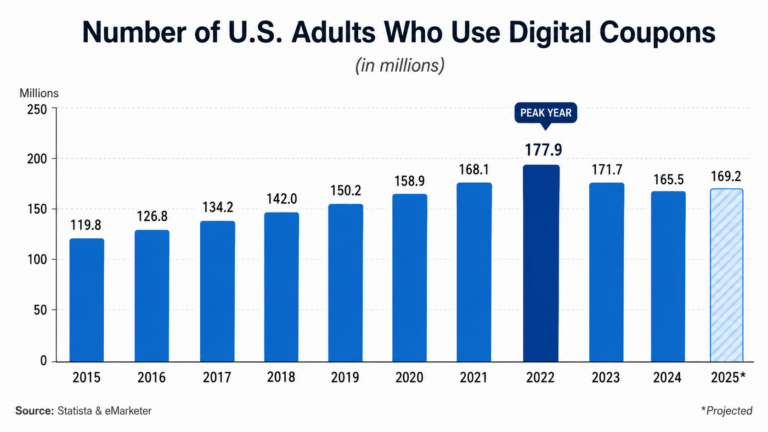
No, couponing is far from being abandoned. Digital coupon usage statistics in the U.S. show an ever-growing number of customers using coupons with a brief Covid-19 outlier peak in 2021 and 2022.
But also, online shops adhere to coupons. This becomes clear when looking at the increasing number of discount codes being published that went from 282,000 in December 2022 to 914,000 in December 2025 according to numbers from SimplyCodes.
But why does everyone feel like the coupon sites are broken? The apparent conclusion is: the system has changed continuously within the last 10 years and what worked well at some point in the past does just no longer work in the now. It seems we passed an important inflexion point a couple of years ago, which made a lasting impact on online couponing and ended the era of coupon platforms and browser extensions as we knew them.
We are in a similar situation as paper coupons were after 2012 – the business environment has changed.
Any Solutions?
Understanding the history of couponing and seeing the current trend, was the reason for start working on this unique app called CouponCrowd. An app that should fix the current couponing situation for customers as well as for shops. An app that is far more than just another coupon code site, platform, or database. This app is on its way to become the personal coupon wallet for all the personalized single-use codes, automatically being extracted and organized for its users, while still being able to provide the benefits your typical coupon database is still bringing to the table.